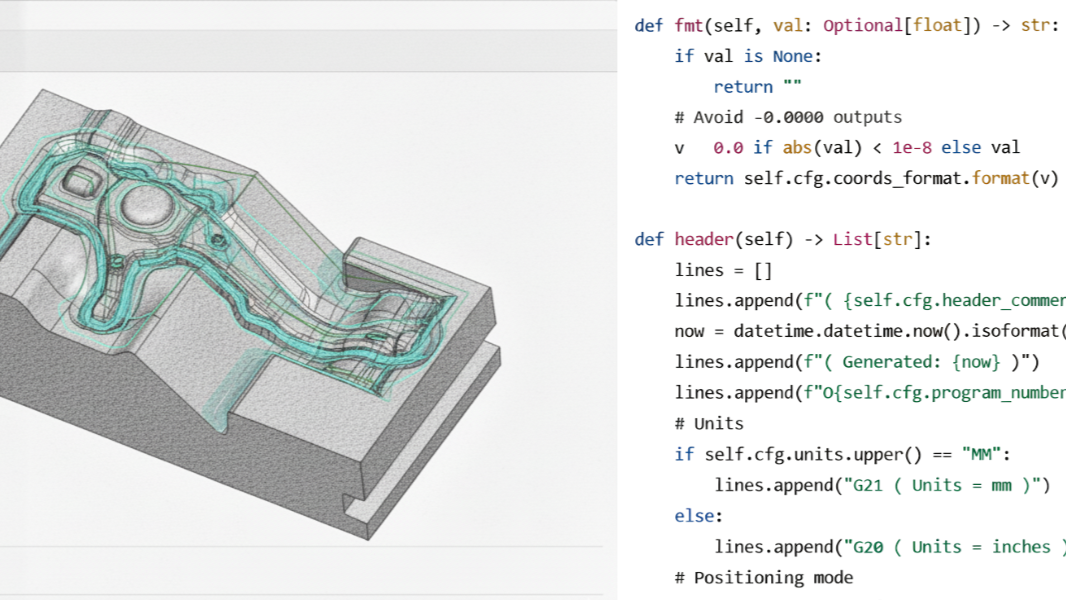
After three decades in the CAD/CAM industry, I've had the unique experience of working extensively on both sides of manufacturing's most persistent divide: the evolution of CAM software and the complexity of post-processor development. Having trained hundreds of users on CAM systems and witnessed the dramatic transformation from months-long training cycles to today's under one-week proficiency claims, I've also spent countless hours wrestling with post-processors that remain as complex today as they were in the 1990s when I started my CAM journey. This perspective from both sides of the table reveals not just a technological gap, but a strategic inflection point that forward-thinking companies are beginning to recognize and address.
The Tale of Two Trajectories
The transformation I've witnessed in CAM software training tells a remarkable story. In the early 1990s, bringing a new CAM programmer to productivity required weeks of intensive training. The interfaces were command-driven, the workflows were unintuitive, and the learning curve was steep. Today, I can train someone to be productive in most modern CAM systems in less than a week. This represents a genuine democratization of manufacturing technology, software vendors invested heavily in user experience, contextual interfaces, and intelligent automation to expand their addressable market.
Yet post-processor development has followed a completely different trajectory. The contrast is striking: today, a relatively new CAM programmer can generate complex toolpaths for intricate aerospace components, multi-axis impellers, or sophisticated mold geometries within a week of training. These same individuals, even veteran CAM programmers with years of experience, often cannot edit a basic post-processor to optimize feeds and speeds or add a simple custom cycle. The time required to train someone to effectively create or modify post-processors hasn't decreased, it still takes months of specialized training to achieve real competency. Industry surveys consistently show that 74% of professionals believe only 1% or fewer CAM programmers can effectively edit post-processors. This creates an absurd situation where programming a complex part is considered routine, but modifying the translator that converts that program to machine code requires rare expertise.
In my three decades of hiring and interviewing manufacturing professionals, I've encountered hundreds of candidates who listed "post-processor editing" skills on their resumes. Yet when presented with real-world scenarios, simple modifications like adjusting headers & footers, adding custom tool changes, or modifying canned cycles, the vast majority could not demonstrate actual competency. This resume inflation isn't due to dishonesty; it reflects an industry where basic post-processor tasks are perceived as advanced skills, and minimal exposure is often presented as expertise. The disconnect between claimed capabilities and practical skills underscores just how artificially complex we've allowed this critical manufacturing component to become.
The historical context makes this disparity even more significant. Post-processors have operated on essentially the same principles since the APT language of the late 1950s, nearly 70 years of fundamental architectural consistency. While CAM software has evolved through multiple paradigm shifts (PC-based systems in the 1980s, 3D simulation in the 1990s, cloud integration in the 2010s, and AI-driven optimization today), post-processors remain what they've always been: machine-specific translators converting generic toolpaths into controller-specific Gcode.
The irony of our current moment is particularly striking: the industry is investing billions of dollars in artificial intelligence for toolpath generation, machine learning algorithms for feed and speed optimization, and generative design engines that can automatically create optimized geometries, yet we're still using post-processor architecture from the 1950s. We're applying 2020s AI technology to generate sophisticated manufacturing strategies, then passing them through translation systems that predate the integrated circuit. This technological time warp represents one of manufacturing's most glaring architectural contradictions.
Understanding Both Sides of the Complexity
Having worked extensively with both CAM software development and post-processor creation, I can appreciate why this dichotomy exists and persists. The technical challenges are real and substantial. Modern 5-axis milling machines are available in multiple kinematic design variants, each requiring unique post-processor logic. CNC controllers implement hundreds of documented Gcode variations, with manufacturers like Fanuc, Siemens, and Heidenhain each maintaining proprietary formats that can't be easily standardized.
From the CAM software perspective, the focus has been on geometric abstraction, creating toolpaths based on universal principles of material removal that work regardless of the target machine. This abstraction enabled the user interface revolution we've witnessed. Modern CAM systems like Fusion 360 and Mastercam can automate toolpath optimization using AI-driven algorithms precisely because they operate at this higher geometric level.
Post-processors, by contrast, must handle the messy realities of physical machines: rotary axis limits, collision avoidance, compensations, and real-time optimization requirements. A well-designed post-processor for a 5-axis mill-turn machine might require several configurable parameters just to define the basic kinematic chain. This isn't artificial complexity, it reflects genuine technical requirements that can't be easily abstracted away.
However, this technical complexity doesn't fully explain the persistence of the skills gap. The real issue lies in where the intelligence resides in the manufacturing workflow.
The Intelligence Distribution Problem
The fundamental architectural challenge becomes clear when you examine where manufacturing intelligence currently lives. CAM software has become increasingly user-friendly by pushing machine-specific complexity downstream to post-processors. This creates an inverted intelligence distribution where the most critical translation layer, the bridge between design intent and machine execution, requires the highest level of specialized expertise.
From a logical system design perspective, the post-processor should be the dumbest component in the entire workflow. Its sole function should be taking what the CAM system has generated and converting it to machine-specific syntax, nothing more. When a tool change is required, all the preparatory work, safety moves, and optimization decisions should be handled in the CAM system where the user can visualize, verify, and modify the process. The user should see exactly what's happening rather than relying on hidden "intelligence" buried in post-processor code that operates as a black box.
Instead, we've created systems where critical manufacturing decisions, collision avoidance, feed rate optimization, tool change sequences, and safety protocols, are relegated to post-processor logic that most users cannot see, understand, or modify. This architectural inversion means that the component requiring the least user interaction (syntax translation) demands the highest expertise, while the component requiring the most user control (manufacturing strategy) has been oversimplified.
This distribution made sense in the early days of CNC when machines were simpler and G-code variations were fewer. But as manufacturing has evolved toward more complex multi-axis machines, diverse controller ecosystems, and demanding precision requirements, we've essentially maintained a 1950s architecture while asking it to handle 2020s complexity.
The result is a system where CAM programmers can design sophisticated toolpaths for aerospace components but can't modify the post-processor when those toolpaths produce suboptimal G-code for their specific machine configuration. This creates operational bottlenecks, vendor dependencies, and missed optimization opportunities throughout the manufacturing process.
Emerging Solutions and Market Signals
The encouraging news is that innovative companies are beginning to address this architectural limitation. Cloud-based post-processor development tools like Manus Software Post Developer now offer graphical wizards and templates that eliminate much of the traditional coding complexity. Solutions like these demonstrate that post-processor development can be simplified without sacrificing functionality.
Advanced frameworks like ModuleWorks GmbH Post-Processor Framework (PPF) with Python-based parametric scripting are reducing initial setup times. ICAM's Adaptive Post-Processing goes further, integrating post-processing, simulation, and optimization into concurrent operations that achieve significant reductions in both programming and cycle time. These innovations prove that fundamental improvements are not only possible but commercially viable.
Even more significantly, these solutions are moving intelligence back into the CAM software where it belongs. Instead of requiring users to understand machine kinematics and Gcode variations, they're building that knowledge into the development tools themselves. This represents the beginning of a more logical intelligence distribution that could eventually make post-processor development as accessible as modern CAM programming.
The Strategic Opportunity
The current market dynamics create a significant opportunity for companies willing to invest in post-processor democratization. The technical barriers that have historically justified complexity are increasingly solvable through modern software architectures, cloud-based knowledge bases, and AI-assisted development tools.
Consider the economic potential: if post-processor development could be simplified to match the accessibility of modern CAM software, it would eliminate one of manufacturing's most significant skills bottlenecks. Machine shops could optimize their CNC programs in-house rather than relying on expensive vendor services. New machine installations could be brought online more quickly. Manufacturing organizations could achieve the full potential of their CNC investments without depending on scarce post-processor specialists.
The market math is compelling. Current post-processor services represent a $1.2 billion annual market built on artificial scarcity. The first company to achieve true post-processor democratization, making it as accessible as modern CAM software, could potentially expand this market by an order of magnitude while capturing significant competitive advantage.
The Path Forward: Completing the Revolution
The CAM industry has already proven that complex manufacturing software can be made accessible without sacrificing capability. The same principles that transformed CAM interfaces, intelligent defaults, contextual guidance, visual development environments, and automated optimization, can be applied to post-processor development.
The key is recognizing that post-processor complexity isn't a technical requirement, it's an architectural choice. By moving machine intelligence back into CAM software where it belongs and treating post-processors as simple translators rather than complex programming environments, the industry can complete the democratization it began with CAM interfaces.
This transformation won't happen overnight, and it will require companies to prioritize long-term market expansion over short-term service revenue. But the early movers, companies like those developing cloud-based post-processor tools and integrated optimization frameworks, are already demonstrating that change is both possible and profitable.
Recommendations for Industry Stakeholders
For CAM Software Vendors: Invest in comprehensive machine intelligence databases that enable CAM software to generate machine-optimized toolpaths from the design phase. Develop visual post-processor creation environments that eliminate programming language requirements while maintaining full customization capability. Consider the competitive advantage of being the first to achieve true post-processor accessibility.
For Manufacturing Organizations: Evaluate the total cost of ownership when selecting CAM systems, including ongoing post-processor development and maintenance expenses. Advocate for simplified post-processor solutions during vendor evaluations. Invest in building internal post-processor capabilities rather than accepting vendor dependency as inevitable.
For Technology Partners: Accelerate development of cloud-based post-processor frameworks and AI-assisted optimization tools. Focus on solutions that move machine intelligence into CAM software rather than adding complexity to post-processor development. Consider the market opportunity in democratizing this critical manufacturing capability.
For Industry Associations: Promote standardization efforts that reduce controller fragmentation while preserving machine-specific optimization capabilities. Support research initiatives focused on manufacturing workflow integration and post-processor accessibility. Facilitate dialogue between software vendors and end users about the real costs of artificial complexity.
The manufacturing industry stands at a unique moment. The technology exists to complete the democratization that began with CAM software evolution. The early signals of change are already visible in cloud-based tools and integrated optimization frameworks. The question isn't whether this transformation will happen, it's whether established companies will lead it or be disrupted by those who recognize the opportunity first.
After 30 years of witnessing both the promise and limitations of CAM technology, I'm convinced that the companies willing to prioritize customer value over artificial complexity will define the next chapter of digital manufacturing. The post-processor revolution is not just possible, it's inevitable.